Funded Research Grants
USDA NIFA Agriculture and Food Research Initiative Predoctoral Fellowship ($180,000), “Characterizing soil microbial communities that suppress powdery scab of potatoes: A comprehensive approach towards disease management”
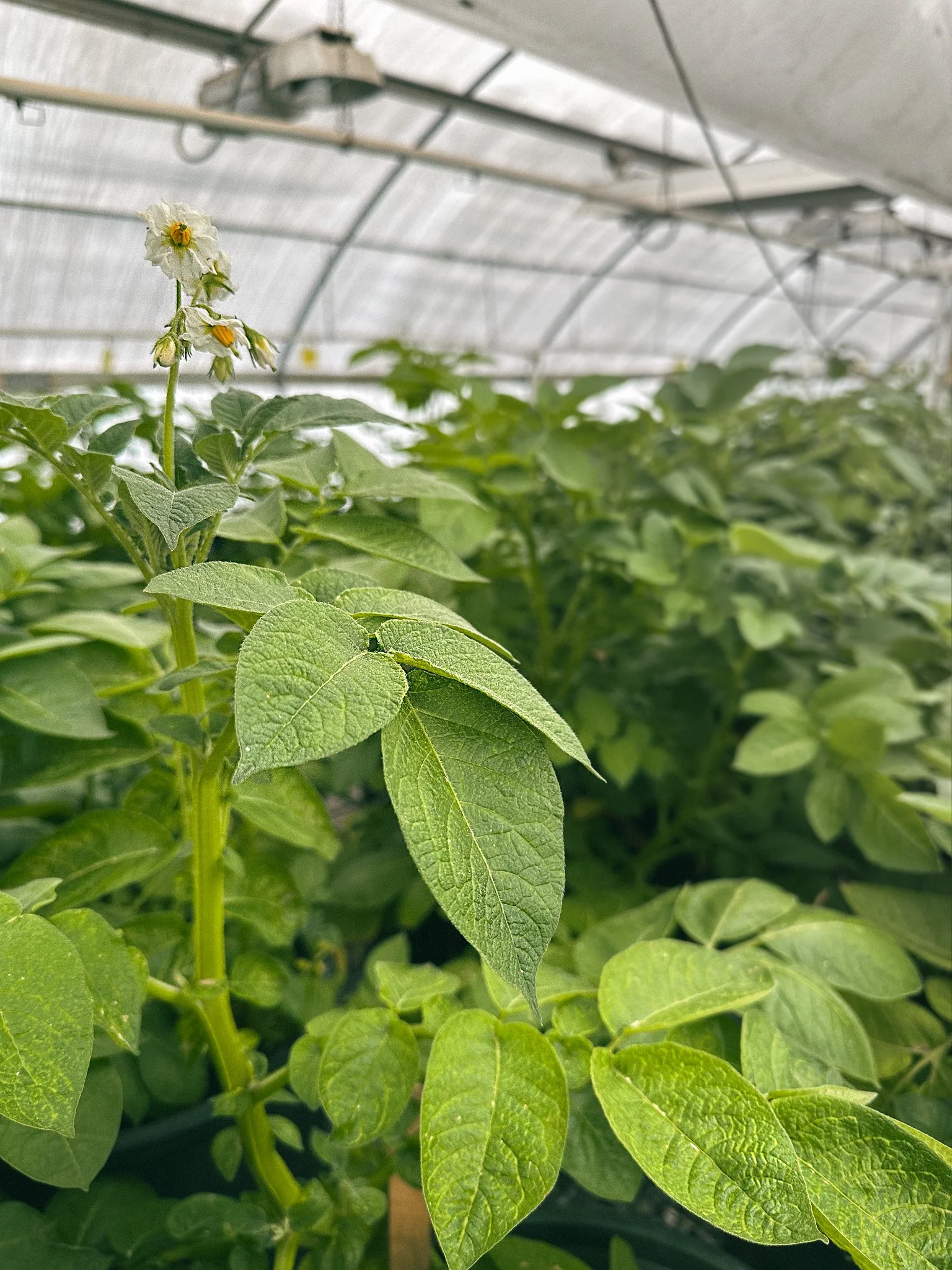
ABSTRACT: Potatoes are a staple food crop globally, critical to food security and economies. However, the potato tuber blemish disease known as powdery scab, caused by Spongospora subterranea f. sp. subterranea (Sss), poses a significant threat. This disease causes blemishes on the tubers, making them unmarketable. Moreover, Sss is the only known vector for the virus, potato mop-top virus (PMTV), which can cause tuber necrosis and result in end-of-season losses for potato growers. Currently, there are no effective management strategies or chemical treatments to suppress either pathogen. To address these challenges, we are investigating how soil microbial communities might suppress powdery scab. We aim to identify of beneficial microbial communities that are associated with suppression of powdery scab by conducting greenhouse experiments with field soils that have been shown to either reduce or support disease. We anticipate that our research will provide the groundwork to develop new tools to help farmers assess the risk of powdery scab and PMTV in their fields. Additionally, we aim to identify agricultural practices linked to disease suppressive activity, allowing growers to adopt practices that promote soil health. In total, results of this project will contribute to the development of disease management strategies that are both effective and economically viable to prevent end-of-season losses caused by Sss and PMTV. We will be sharing our progress and findings with the agricultural community and the public through an established LinkedIn profile and peer-reviewed publications. This initiative is a crucial step towards securing the health and productivity of potato crops, benefiting both growers and consumers.
WesternSARE Graduate Student Grant ($29,823), “Control of Powdery Scab of Potato with Disease Suppressive Soils”
ABSTRACT: Potatoes (Solanum tuberosum L.) are the fourth most important food crop in the world and, in 2020 the total value of all potatoes sold Idaho, Oregon, and Washington was $1.82 billion. This proposal addresses powdery scab a potato blemish disease that results in losses to all market sectors of potato in all major production regions of the U.S. Powdery scab reduces potato aesthetics for directly marketed potatoes and through the transmission of potato mop-top virus (PMTV), a virus that causes tuber necrosis leading to rejection of potatoes used for processing. Complete host resistance to powdery scab is not available in commercially accepted varieties and no management tactics alone or in combination have successfully controlled all phases of the disease. In this project, we plan to use culture-free methods to characterize microbial communities in bulk and rhizosphere soils that are associated with reduced disease and may be responsible for powdery scab suppressive activity. Our research objectives are to 1) characterize the temporal dynamics of the potato rhizosphere microbiome through the growing season and in relation to powdery scab development and 2) assay soils for their ability to suppress powdery scab. Our goal is to identify biotic factors that are associated with disease suppressive activity of soil and identify and management practices that promote disease suppressive activity. Our educational objective is to engage growers in the project and communicate our findings to the stakeholder community, at grower education events, through the dissemination of extension publications, and the research community via peer-reviewed publications.
Peer-reviewed publications
Hislop, L. M., Luby, C. H., Loarca, J., Humann, J., Hummer, K. E., Bassil, N., Zhao, D., Sheehan, M. J., Casa, A. M., Billings, G. T., Echeverria, D. M., Ashrafi, H., Babiker, E., Edger, P., Ehlenfeldt, M. K., Hancock, J., Finn, C., Iorizzo, M., Mackey, T.,... Hulse-Kemp, A. M. (2024). A Blueberry (Vaccinium L.) Crop Ontology to Enable Standardized Phenotyping for Blueberry Breeding and Research. HortScience. https://journals.ashs.org/view/journals/hortsci/59/10/article-p1433.xml
Meyvantsson, I., Vu, E., Lamers, C., Echeverria, D. M., Worzella, T., Echeverria, V., Skoien, A., & Hayes, S. (2011). Image-based analysis of primary human neutrophil chemotaxis in an automated direct-viewing assay. Journal of Immunological Methods, High-Throughput Methods for Immunology: Machine Learning and Automation. https://www.sciencedirect.com/science/article/abs/pii/S0022175910003947